

ITTech Pulse Exclusive Interview with Sergio Gago CTO at Cloudera
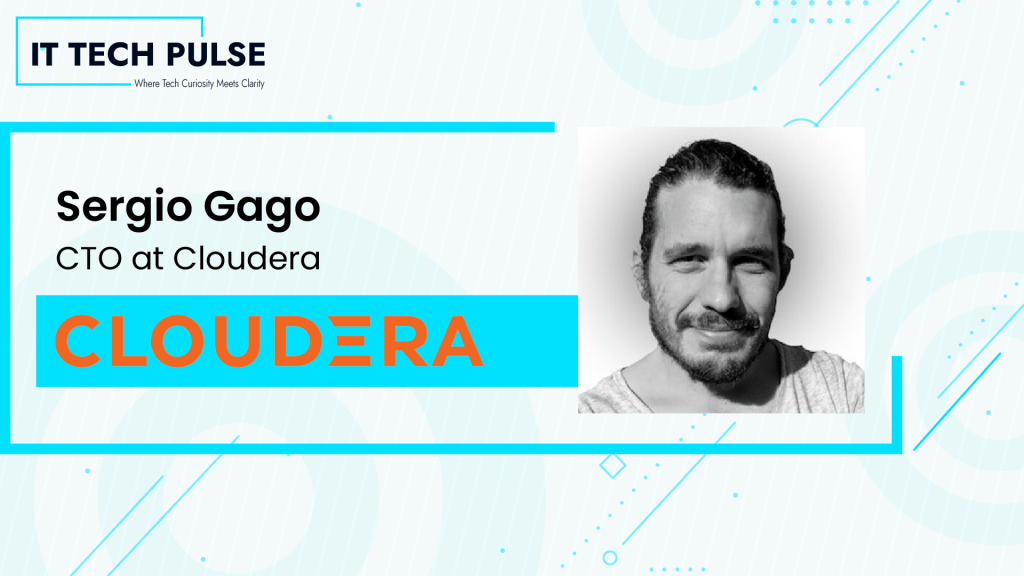
Welcome to ITTech Pulse! We chat with Sergio Gago, CTO at Cloudera, leads global AI and data innovation. With two decades in AI and quantum computing, he drives secure, scalable, and enterprise-ready technology transformation worldwide.
What has been the key driver behind your passion for technology and AI, and how has that influenced your journey to becoming CTO at Cloudera?
I’ve always been passionate about applying advanced computing to solve complex, real-world problems where innovation must coexist with responsibility. From AI and big data to Quantum Computing. Early in my career, I founded and led several startups, which taught me the importance of speed, experimentation, and adaptability. Then I joined Moody’s through a machine learning acquisition, where I led AI and quantum computing initiatives focused on applying these technologies in large-scale, highly regulated environments. That experience deepened my understanding of how engineering and governance can work together effectively, which is exactly what led me to Cloudera.
Read More: ITTech Pulse Exclusive Interview with Jay Lindenauer Vice President of Network Security WatchGuard
What I love about Cloudera is that it’s where open architectures and enterprise rigor meet. Cloudera co-created the Big Data industry. Our mission is to bring AI to data anywhere it lives. We’re continuing to build on that vision, and when I look to the future, I see enormous potential for innovation and industry disruption. What we hear from our customers is that they want more from agents and generative AI. To achieve this, we must ensure their data is governed, portable, and accessible wherever it resides. My role is to make that convergence real by linking practitioner speed with platform-level security and policy. For me, this work isn’t about chasing novelty; it’s about embedding AI meaningfully into enterprise operations. Right from where it happens. The evolution of AI from experimentation to a strategic cornerstone makes this both urgent and rewarding.
Cloudera’s recent survey shows 96% of enterprises are embedding AI into their core processes. From your perspective, what factors have accelerated this massive adoption of AI in enterprises?
This represents a major transformation in how enterprises are adopting and operationalizing AI. In 2024, we found that 88% of enterprises were using AI, while our latest 2025 survey shows an 8-point increase to 96%, indicating that AI has transitioned from experimental to essential. In short, AI is no longer an innovation effort. It is embedded at the core of enterprises.
There are three main factors driving this acceleration:
- Measurable business impact: Organizations are realizing tangible results from their AI initiatives, with 52% of leaders reporting measurable value and only 1% saying they have yet to see any results. This further demonstrates how much AI has progressed beyond proof-of-concept to deliver tangible results.
- Improved data trust and accessibility: Nearly two-thirds of respondents said they trust their organizational data more than they did a year ago, which builds confidence to use AI effectively.
- Maturation of hybrid and multi-cloud architectures: These architectures allow enterprises to operationalize AI securely using data where it already resides, removing barriers related to latency, risk, and compliance.
Together, these trends signal a market that is ready for AI everywhere, where innovation aligns with governance and measurable ROI. At Cloudera, we are in the right place to support enterprises as they navigate these changes.
How does Cloudera’s approach to hybrid data architecture help enterprises overcome challenges related to AI scalability and security?
Enterprises once relied on a single data environment, but our survey shows that this is changing rapidly. Sixty-three percent of respondents report using a private cloud, 52% use a public cloud, 38% maintain on-premises mainframes, and 32% leverage a distributed architecture. This confirms that enterprise data is everywhere, and success depends on being able to securely govern and analyze all of it. Traditionally, companies could never fully bring those environments together. Without full access, organizations struggle to make fully informed decisions and are unable to utilize the full potential of AI.
Read More: ITTech Pulse Exclusive Interview with Miguel Turnbull Director of Partner Development Infobip
That’s why Cloudera is the only data and AI platform company that large organizations trust to bring AI to their data anywhere it lives. With our data-anywhere approach, enterprises can apply AI without moving or duplicating sensitive data, maintaining lineage and governance across clouds, data centers, and the edge. The survey reveals that leaders’ top priorities for modern architecture include integrated AI/ML Operations (52%), automated pipeline orchestration (51%), and granular governance (44%). Therefore, we have built our platform to deliver these results. With a single unified platform, our architecture ensures consistency and control, resulting in fewer one-off stacks, improved cost predictability, and enhanced resilience.
Your survey highlights the importance of data accessibility and integration for AI success. What strategies do you recommend enterprises adopt to improve their data architecture?
The survey makes one thing clear: AI success depends on having complete and accessible data, but most enterprises are not yet equipped to achieve this. Only 9% of respondents said all their data is accessible for AI initiatives, and 61% said siloed data makes scaling AI difficult. In many companies, even the teams responsible for cloud and data center operations are miles apart! This highlights the importance of leaders modernizing their data architectures to close the accessibility gap and enable AI to deliver its full potential.
To achieve this, organizations should focus on three key priorities: integration, governance, and automation. Integration begins with unified, automated data pipelines that integrate both structured and unstructured data to ensure consistency across environments. Governance fosters trust and control over data, a theme that remains a priority, with 24% of survey respondents reporting that they trust their data more than they did last year. This number will continue to grow as access controls and policy enforcement become stronger. Finally, automation streamlines management and removes bottlenecks. The survey found that enterprises using modern architecture, such as data lakehouses, saw improvements in operational efficiency (34%) and compliance (22%).
Together, these strategies ensure that AI models are drawing from high-quality, well-governed data while maintaining compliance. Enterprises that follow these steps will be well-positioned for faster and more reliable ROI in the future.
Security around AI initiatives is a big concern, as noted in your research. How does Cloudera address these security challenges, especially around private AI and data governance?
The conversation around security is growing, and it will only continue to do so. Nearly half of respondents cited security and compliance as major barriers to AI adoption, highlighting the importance of delivering solutions that address private AI and governance. This is why companies experimenting with AI without incorporating compliance, cybersecurity, or legal considerations are bound to fail. Those need to be present from the beginning. Front and center.
Cloudera’s platform is designed to address the challenges respondents identified, including data leakage during training and unauthorized access. By enabling enterprises to bring AI to their data anywhere, we ensure that sensitive information never leaves a controlled environment. This includes data classification with policy enforcement and granular access by data type. Our data-anywhere platform supports AI deployment behind the firewall, combining regulatory compliance with flexibility. This approach reduces exposure risk and increases confidence in the ability to secure data used in AI systems. In short, if your agents will be conducting business activities, they need to have the same level of data governance (if not more) as your employees.
With generative AI and other AI forms gaining prominence, what trends do you see shaping enterprise AI strategy in the next 2–3 years?
Our study revealed that 67% of respondents feel more prepared to manage new types of AI. Beyond generative models, many are now deploying deep learning, predictive, and agentic AI models as they become more comfortable with these technologies and move from basic automation to intelligent, adaptive systems. Over the next few years, I see three trends defining enterprise AI strategy:
- Agentic AI: Autonomous systems that act and collaborate will increasingly support decision-making. In the next few years, we will see the rise of the digital colleague, where enterprises will have to merge the work of humans and agents.
- Data trust and governance everywhere: This will deepen as organizations secure and scale new workloads. From meta catalogs to lineage and auditability.
- Hybrid, multi-model architectures: These will become standard as enterprises seek flexibility while maintaining oversight. Where you deploy your models (pay per token or pay per GPU), how you combine your compute on-prem and cloud and adapt to local regulations, while being resilient to outages in the cloud.
Our survey shows that businesses prioritizing integration, governance, and operational efficiency are best positioned to capitalize on the next phase of intelligent autonomy.
What are the biggest obstacles enterprises face in maximizing AI’s potential and ROI, and how can leaders best navigate these challenges?
The top challenges enterprises face include data integration (37%), storage performance (17%), and limitations in compute power (17%). These are often linked to siloed data, which remains a key barrier to scaling AI. Another major issue is cost: 42% of respondents said compute costs are becoming too high.
Overcoming these barriers requires a shift from fragmented data estates to governed, hybrid platforms that centralize policy while distributing compute. It also comes back to accessibility. Leaders must work to close the accessibility gap and ensure that data can be used securely across environments. To maximize ROI, enterprises need clear visibility into data lineage, optimized cost management, and seamless collaboration between data teams and business units.
What advice would you give to technology leaders today who are aiming to foster a more data-driven culture within their organizations?
Being data-driven is no longer optional. The report finds that 86% of organizations are at least moderately data-driven, but only 24% say their culture is “extremely” data-driven. Closing this gap starts with leaders who align culture, technology, and talent around modern architectures. This has to apply to every corner of the company. Therefore, distributing the data and the insights becomes paramount.
Begin by focusing on visibility and trust in data as the foundation of a data-driven organization. While more enterprises report higher confidence in their data, there is still room for improvement. Strengthening that trust requires consistent governance and automation. Our report found that 51% of leaders consider automating data orchestration a top priority, showing many are taking steps to ensure secure and reliable data flows. Once a well-governed data foundation is in place, organizations can empower teams to experiment and deploy AI effectively. With access to secure, high-quality data, teams can innovate more quickly and feel more confident in driving business impact. In short, with machine learning, we typically say “garbage in – garbage out” to define models trained with bad or biased data. AI agents now take that to the extreme. If companies don’t have a good data orchestration and curation system, their agents will be nothing but parrots repeating bad information instead of great advisors supporting our decision-making with infinite access to verified information.
As the CTO, what innovation or development at Cloudera excites you the most in the AI space currently?
There’s a lot to be excited about, but what excites me most is the convergence of data anywhere architectures with next-generation AI. This shift is already taking shape across the enterprise landscape. With advantages such as greater efficiency and stronger governance, we’ll continue to see how organizations scale AI without compromising compliance.
At Cloudera, we’re advancing that vision with innovations that allow customers to apply AI to 100% of their data, regardless of where it resides. We’re seeing that unified approaches across cloud, on-prem, and edge environments drive the highest ROI and security confidence. As a result, we’re continuing to enable private and agentic AI capabilities that operate seamlessly across environments, bringing intelligence to the data rather than moving data to the intelligence.
To wrap up, what is the most common misconception about AI integration you encounter with enterprise clients, and how would you clarify it?
One of the biggest misconceptions about AI integration is that adopting AI requires centralizing all data into a single cloud or platform. In practice, most enterprises already operate across multiple environments. Our survey found that 38% of respondents still rely on on-premises mainframes, and 32% on distributed systems, indicating that data will continue to reside in multiple locations to meet operational and regulatory needs. This is why a distributed structure remains the most practical model for enterprises.
The real opportunity lies in creating a consistent experience that unifies all data sources under a single framework for governance and security. As I’ve mentioned before, the key to success is bringing AI to the data wherever it resides. This approach eliminates duplication and risk while driving greater efficiency and ROI. Hybrid isn’t a compromise; it’s the foundation for secure, scalable, and enterprise-ready AI.
Thank you, Mr. Sergio, for sharing your insights with us.
Write to us [wasim.a@demandmediaagency.com] to learn more about our exclusive editorial packages and programmes.
Sergio Gago is the Chief Technology Officer at Cloudera, where he leads the company’s global technology strategy focused on bringing AI to data anywhere it resides. With more than two decades of experience spanning AI, quantum computing, and data-driven architectures, he has built a career at the intersection of innovation, scalability, and governance.
Before joining Cloudera, Sergio served as Managing Director of AI and Quantum Computing at Moody’s Analytics, where he led the company’s generative AI strategy and oversaw the integration of advanced analytics across financial modeling and risk assessment platforms. He previously held CTO roles at Rakuten, Qapacity, and Zinio, and was CEO of Acquire Media, which he successfully sold to Moody’s in 2020.
A serial entrepreneur, Sergio founded five technology startups before the age of 25—three of which remain active today. He also serves as Academic Coordinator for the Master in Big Data and Artificial Intelligence program at Barcelona Technology School, where he teaches courses on AI, data ethics, and emerging technologies.
Having lived in seven countries, Sergio brings a global perspective to leadership and team building. He is also an angel investor in deep-tech and data-driven startups. Outside of work, he is an avid ocean conservationist, scuba diving instructor, and musician.
Sergio is a strong advocate for trusted data infrastructure and believes AI will evolve into the operating system of the enterprise by 2030.
Cloudera is the only data and AI platform company that large organizations trust to bring AI to their data anywhere it lives. Unlike other providers, Cloudera delivers a consistent cloud experience that converges public clouds, data centers, and the edge, leveraging a proven open-source foundation.
Cloudera empowers businesses to apply AI and assert control over 100% of their data, in all forms–whether it is in Cloudera or anywhere in the entire data estate–delivering unified security, governance, and real-time insights. The world’s largest organizations across all industries rely on Cloudera to transform decision-making and ultimately boost bottom lines, safeguard against threats, and save lives.


