

Is Google Search Really Falling Apart?
Stay updated with us
Sign up for our newsletter

Has Google search become a lot worse than you think?
Look at this.
Let’s search How to do Digital Marketing?
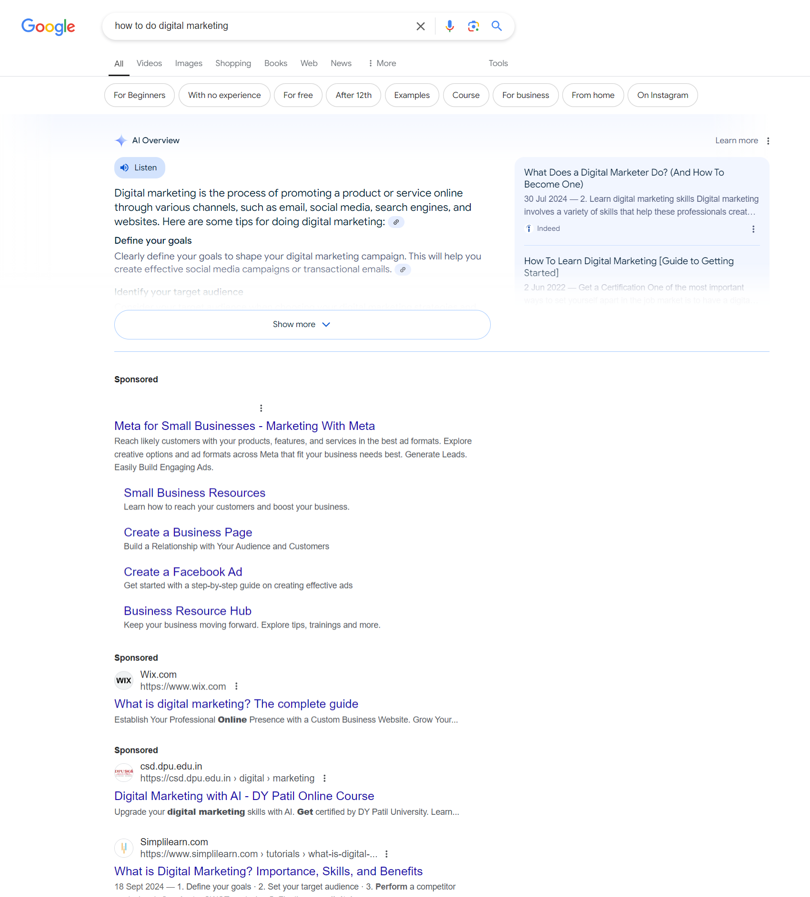
The 1st result you see is AI Overview by Google which is basically the summary of the content being published on Google. (Always having a chance of not being correct, as its experimental).
Then, there are 3 adverts – all first three results are sponsored links.
Imagine if you click on our blog and all you see are advertisements before you even get onto the content.
Google used to be magic; its easy to take for granted now-a-days but the ability to just find anything you wanted within like 5 seconds was revolutionary when it was new but I have been noticing more and more over last few months – things starting to feel a little off.
So I’ve done a deep dive.
Thanks to Google I have found 3 major reasons as to why Google search is not just in decline but its broken now. And the way they started changing this – Results page is the first.
Look at this again.
Do you notice something?
Aside from the fact that four ads before your content feels almost violating, the thing that’s even worse is when you consider something called the fold.
The fold is the imagined line where if you want to see anything past it, you have to take action like scrolling down.
The term comes from newspapers where you’d want to put the most important information not just on the front page but specifically on the top half of that front page so that people can see it even when the paper is folded up in stacks above the fold.
Now, newspapers never got to a stage of having so much power that they could regularly afford to stick big adverts across their fold. They needed the fold to convince people to get the paper in the first place.
But compare that to now where the entire fold is just sponsored content and it’s starting to feel like Google’s gotten too comfortable.
Google has become so at ease that they don’t even feel like they need to convince people to use them anymore.
Google used to pride itself specifically on how quickly their search engine finds you an accurate answer. But now you’re either having to specifically invest more time just to scroll past their ads or trust that the ads always have what you want (spoiler: they do not).
Otherwise, those posts would be at the top organically without having to pay to get there. Oh, and you might have forgotten, but a decade ago, these sponsored links used to be highlighted in yellow, indicating to the user in a very obvious way that these aren’t organic search results so that you could just filter them out. Sometimes they were in their own cordoned-off section to the right of the results.
Not anymore. Now the sponsored search results look exactly like the genuine search results, apart from a tiny little, much less obvious sponsored text.

It didn’t always work like this. Google, when they started out, did not use to make a lot of money, and that was on purpose.
You know, there was a time when Google would receive actual fan mail with checks and cash inside from people saying, “We love your product, and you deserve to be making more money than you are.”
And that’s because of the founders who, in their original paper presenting Google to the world, specifically said, “Advertising income often provides an incentive to provide poor quality search results. We believe the issue of advertising causes enough mixed incentives that it is crucial to have a competitive search engine that is transparent and in the academic realm.”
And yet, here we are in Q2 2024. Google made $842 billion in revenue, 76.3% of which came from ads, and about 75% of that ad revenue is specifically from Google search ads alone, as opposed to YouTube ads etc.
But okay, you probably catch my drift by this point. Google search results page is starting to look an awful lot like an old 2000’s web portal, which is ironic because one of the biggest reasons that Google actually beat Yahoo to become the world’s de facto library was because they specifically didn’t try to be one.
Well, Yahoo did, because they knew they’d make more money if they kept people on their own pages as much as possible.
But it’s at this stage into my deep dive that I came to my second realization that while Google has fallen from grace, changed who they are, and started to put the user’s experience second, it’s not all Google’s fault.
A lot of what’s been making it so hard to find the right web page these days is also down to the people making them. If you work online in any capacity, really, or you know, you just have really boring friends, you’ll have heard of search engine optimization or SEO.
SEO has become a massive industry with a market size valued at $75.13 billion in 2023, projected to reach $170 billion in 2028.
The basic idea is about analyzing the way that Google’s algorithm ranks pages and then employing various tricks to make your page look as good as possible to that algorithm so that you get placed higher and therefore clicked more. And as the algorithm has changed, so have the kind of tricks you see being used.
Like, for example, you used to be able to boost your visibility just by having lots of reviews associated with your business, even if those reviews are negative, which led to, for instance, a scam in which a man named Vitaly Borker deliberately sent damaged or fake glasses to customers, hoping they would be angered enough to review bomb him, knowing that it would promote his site.

But nowadays, you’ll see these problems instead: sites including buzzwords to capture as many possible search queries as you can think of.
That’s why so many AliExpress listings have incomprehensible names that are just a string of largely unrelated words.
And it’s why articles like recipes, which should be so simple, have to start off with paragraphs of preamble about how grandma always made the best cozy warm winter autumn cookies 2024.
Yeah, man, relatable!
People updated old articles even if they did none of the new research, but literally just changed the title to 2024.
So many times I had been browsing the best something in 2024, and I would slowly realize as I scrolled through the list that not a single one was from 2024.
The website used to effectively try to scam by recommending old results that made no sense today. They would have erased all mentions of it being written in 2021 or 2022. And as far as Google’s rules were concerned, if an article had been edited in 2024, it was a 2024 article.
However, I have noticed that google have changed it recently, and the search results now show the results which are written in 2024.
Let’s search cybersecurity trends in 2024.

Do you notice something???
All of these results are from the articles which are published in 2024 and not just edited in 2024; this wasn’t the case earlier.
Companies, especially those with lots of ads on their pages, are trying everything they can to rank really highly for searches that are totally unrelated to their brand because they know it’ll get them lots of clicks and lots of revenue. Like why does Forbes have so many articles on supplements? Well, because supplement ads pay a lot of money.
But here’s the kicker: the only companies who are pumping out this much content and paying to boost their visibility as much as possible are the ones with a monetary incentive to do so. And the way they do that is being flooded with affiliate links.
You can see this very much in action because there are papers showing that only a small percentage of review articles actually use affiliate marketing, but the majority of the results that come up on a search do use affiliate marketing. And that means it’s got to a stage now where searching for the best of basically anything is pointless. Almost every single article is a top 10 of products not selected based on their merit, but in fact, just whether or not they’ll get a kickback when you buy them. How many times have you reached the number one recommended product in these lists only to find that it’s clearly an imported product from China being sold for multiple times what it’s worth?
I can guarantee that a large slice of these articles are written with the writer not actually having bought and tested all 10 products themselves, but instead having gone onto Amazon, searched for the highest-rated products (ideally expensive ones so they can make more from the affiliate links), and spent 1 hour max compiling them into a list before spamming that list with buzzwords to try and capture as many people as possible who will actually trust this research.
So why doesn’t Google just fix it?
Well, determining the quality of a result is actually really complicated. The best that they are able to do right now is to factor in the reaction of the users from a Google presentation.
What’s crazy is that we don’t actually understand documents beyond some basic stuff. We hardly look at documents; we look at people. If a document gets a positive reaction, we figure it is good. If the reaction is negative, it is probably bad. Grossly simplified, this is the source of Google’s magic.
What this means is if a page is ranking high. It’s getting lots of clicks and those people end up on that page for ages, scrolling through the meer of deliberately vapid text interlaced with ads to find the actual answer they came for, then the algorithm figures, “Hey, they spent a long time there. That must be good.” And the vicious cycle continues.
But here’s the thing, let’s assume that these AI popups work perfectly 100% of the time, which is obviously the goal that Google’s striving towards.
How does that help all the sites that have helped to first gather that info, the sites who’ve done the work, research, and publishing the content that it seems like Google is using to train their AI to answer it? Doesn’t it?
As a matter of fact, it actually seems an awful lot like Google is trying to replace those sites.
And on one hand, you could argue that, you know, AI summaries are amazing and they’re going to make the search experience even faster.
But after doing all of this digging, I’m starting to feel a slightly different way. What’s to stop Google from deciding to use its AI to eventually replace the need to visit any other website? So you spend your entire browsing session within Google search page itself, and then the only way to get ahead of the AI is to pay for it. That way, the entire time you use Google, you’re paying Google in some way or another.
Maybe that’s not the world that Google wants to build, but it’s hard to argue that they’re not moving closer towards it. And it’s effectively where online services start off by enticing users with a high-quality product.
When the users are locked in, they make it worse for them to better serve their business customers. And then finally, once both sides are locked in, they start shafting all of them to maximize profits for themselves. By which point, oops, we don’t have a desirable product anymore.
And I think it’s fair to say Google is taking some big swings into that final stage here. And it’s going to sting their business customers even more than usual, considering that the very mechanism that they’re using to make things harder for them, this AI that they’re now having to compete against, only works by stealing their content anyway.
It’s crucial for search engines to prioritize user experience and provide accurate, relevant results. Hopefully, Google will recognize these issues and take steps to improve their search platform.


